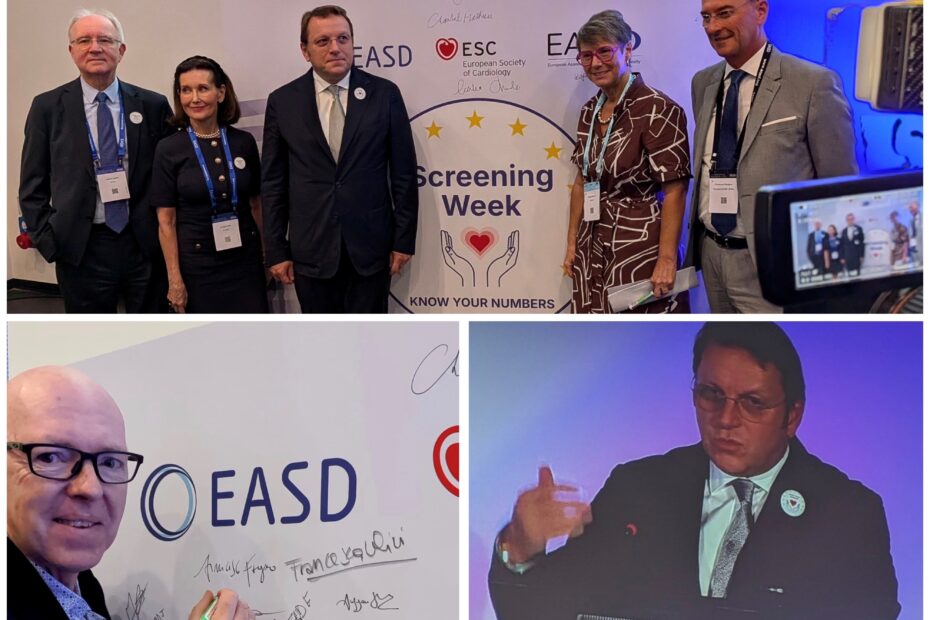
The 29th of September marked the official launch of the first-ever EU Screening Week, which encourages citizens across Europe to “Know Your Numbers” by checking key health indicators such as blood pressure, cholesterol, and blood sugar. The initiative was launched at the EASD Annual Meeting of the European Association for the Study of Diabetes, where European Commissioner for Health Olivér Várhelyi joined EASD President Francesco Giorgino, and other presidents of leading scientific associations to highlight the importance of screening initiatives in improving public health.
For DiaUnion and Program Director Finn Stensbjerg Kristensen, it was particularly encouraging to see that type 1 diabetes was part of the conversation. During the launch event, moderated by Prof. Chantal Mathieu, the importance of early detection of T1D was explicitly recognised, including in the discussion with Commissioner Várhelyi. The strong support for making EU Screening Week a recurring initiative is another positive step towards strengthening prevention and earlier diagnosis across Europe.
Every year, an estimated 25,000-30,000 children and young people in Europe are diagnosed with type 1 diabetes. Thirty years ago, that number was roughly half. Meanwhile, the Nordic countries have become a global hotspot for T1D, with some of the highest incidence rates in the world.
Early detection can help reduce severe complications at diagnosis and support families in preparing for a life with type 1 diabetes. It is also becoming increasingly important, because it enables access to new disease-modifying treatments that can delay the clinical onset of T1D, but require the identification of individuals in the early stages of the disease.
We therefore welcome the launch of EU Screening Week and the growing European focus on prevention, screening and early detection. Now we need to ensure that type 1 diabetes remains part of this agenda and that Europe moves towards a more coordinated approach to early detection.
Because when it comes to type 1 diabetes, earlier detection is prevention.
